
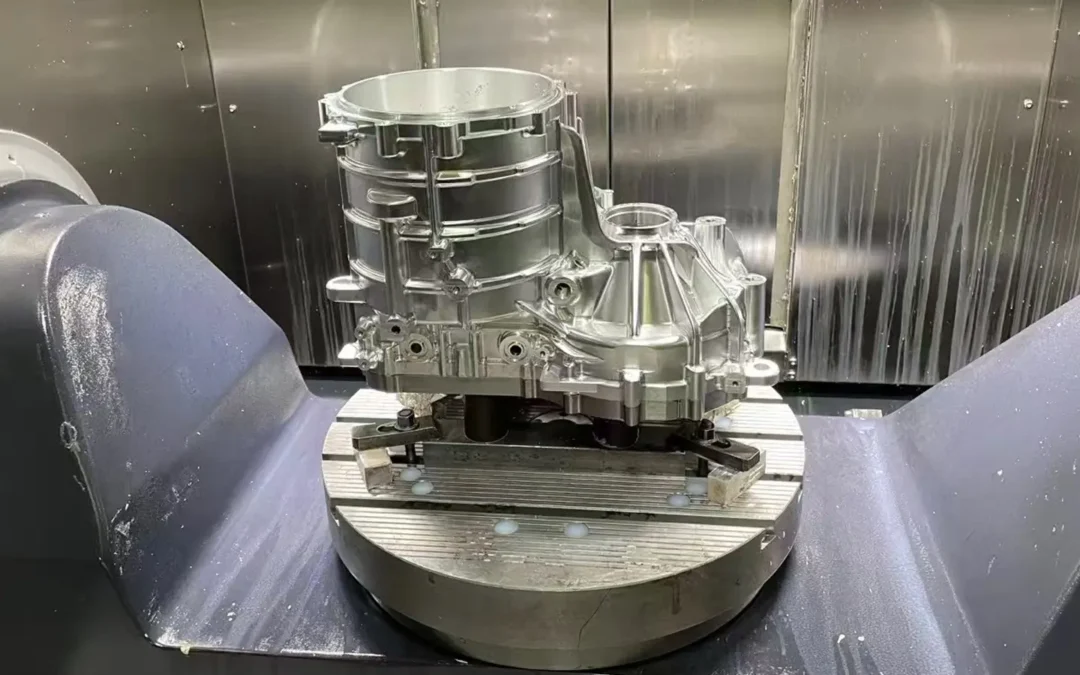
CNC precision radius-matched pocket milling has transformed the manufacturing of modern turbine hub cavities, enabling unprecedented levels of dimensional consistency, stress-optimized geometry, and multi-depth pocketing accuracy. As turbine engines evolve toward lighter structural architectures and higher rotational efficiency, hub cavities have become increasingly intricate. These cavities often incorporate variable depths, multiple intersecting radii, asymmetric structural contours, and blended transition zones that cannot be produced with conventional machining methods. Multi-depth hub cavities play a critical role in distributing rotational loads, managing thermal gradients, integrating cooling pathways, and optimizing airflow within the hub assembly. But their complexity demands extremely precise machining control, particularly at the interface where multiple radii merge to create smooth, load-balanced transitions. CNC precision radius-matched pocket milling ensures these geometry-sensitive areas retain their structural intent while eliminating stress-inducing discontinuities. The process integrates advanced multi-axis kinematics, radius-adaptive toolpath programming, and stable tool engagement strategies to achieve smooth pocket floors, clean wall curvature, and accurate depth transitions—even in deep, narrow, or reverse-curved hub cavities. Because turbine hubs operate in extreme thermomechanical environments where structural integrity is non-negotiable, achieving precise radius matching across every pocket and depth layer is crucial for long-term engine reliability, fatigue resistance, and high-efficiency performance.
The complexity of machining multi-depth turbine hub cavities arises from the geometric behavior of the cavity itself. Each cavity may include several depth layers, sweeping radii, intersecting pockets, tapering walls, compound curves, and step-down regions that require continuous adjustments in cutter orientation and programmed geometry compensation. Modern CAM technology plays a pivotal role in this area, enabling radius-aware toolpath generation that conforms precisely to curvature transitions at every depth. High-precision CNC platforms can execute simultaneous 5-axis movements that maintain constant tool-to-surface orientation, ensuring uniform chip load and eliminating chatter in areas where geometry shifts abruptly. Specialized cutting tools, such as lollipop cutters, tapered ball-nose mills, and novel barrel tools, enhance stability when navigating deep-reach zones or matching compound radii within confined pocket geometries. The goal is to maintain a smooth, uninterrupted surface flow across every radius transition, preventing flat spots, over-cutting, or cusp formation—all common problems in conventional multi-depth machining. Through simulation-driven programming, engineers can map the curvature behavior of each hub cavity before cutting begins, predicting where tool deflection, heat build-up, or kinematic interference might occur. This preparation ensures that the final machined cavity matches the digital design model with micrometer accuracy. With turbine hubs often exposed to high-cycle fatigue environments and extreme rotational pressures, precise multi-depth radius matching is essential to maintaining structural cohesion and smooth stress distribution throughout the hub.
Surface integrity is one of the most critical outcomes of CNC precision radius-matched pocket milling, particularly because multi-depth turbine hub cavities must withstand intense cyclic loading, elevated temperatures, and continuous vibration during engine operation. These cavities are typically machined from high-strength alloys such as Inconel, Waspaloy, titanium, or powder-metallurgy-based superalloys—materials known for their toughness and poor machinability. Even slight instability during cutting can produce micro-tears, directional scratches, heat-affected zones, or burr formations that severely compromise fatigue life. Ultra-stable finishing strategies are therefore essential. CNC platforms with high-stiffness spindles, thermal-controlled enclosures, harmonic-suppression systems, and adaptive feed modulation help maintain consistent tool engagement across the entire cavity geometry, including areas where the curvature changes abruptly or the pocket deepens sharply. Advanced coolant strategies—such as through-tool coolant delivery, high-pressure flushing, and cryogenic cooling—further ensure thermal stability, preventing the metallurgical degradation associated with excessive heat. The final result is a surface profile that meets or exceeds aerospace specifications for roughness, uniformity, and microstructural integrity. Smooth radius-matched surfaces minimize crack initiation, improve airflow behavior for cooling passageways, and reduce localized stress amplification. For manufacturers, this level of surface control directly translates into higher engine durability, extended hub service life, and reduced maintenance intervals, making precision radius-matched milling an indispensable process in aerospace component production.
In addition to quality, CNC precision radius-matched pocket milling significantly enhances the repeatability, scalability, and efficiency of turbine hub cavity production. Modern aerospace supply chains require the ability to manufacture consistently identical hub geometries across dozens or hundreds of units, with tight control over every radius, depth layer, and wall contour. State-of-the-art CNC equipment incorporates closed-loop feedback systems, high-resolution linear scales, automated in-process probing, and machine learning algorithms that monitor tool wear and automatically adjust toolpaths in real time. When a cutter begins to dull or thermal drift affects the machine axes, the system compensates by modifying offsets, speeds, and feed rates—ensuring that the cavity geometry remains unchanged. Robotic handling systems, palletized workholding, and integrated quality control processes allow for continuous, unattended machining cycles without sacrificing accuracy. Each cavity, regardless of depth complexity, emerges fully compliant with aerospace dimensional standards, minimized variation, and near-zero scrap. These automated refinements are essential for supporting both prototype development and full-scale production programs. As turbine OEMs move toward more advanced hub architectures with increasingly intricate cavity designs, CNC precision milling enables streamlined production timelines, reduced rework, shorter inspection cycles, and enhanced traceability. The resulting improvements in cost-efficiency and throughput are critical for meeting demanding aerospace production schedules while maintaining the highest quality standards.
Looking ahead, the evolution of CNC precision radius-matched pocket milling will continue to shape the future of turbine hub cavity design and manufacturing. As aero-engine engineers push toward higher bypass ratios, hotter turbine inlet temperatures, and more aggressive weight-reduction strategies, hub cavities will become more geometrically complex and multi-functional. This will place even greater emphasis on ultra-precision machining controls, AI-enhanced toolpath optimization, and next-generation multi-axis capabilities. Digital twin environments will allow machinists and engineers to simulate not only toolpaths but material behavior, thermal response, and stress distribution within each cavity before machining begins. Advanced tooling innovations—such as nano-coated cutters, polycrystalline diamond hybrid tools, and ceramic-reinforced cutting edges—will enable more efficient material removal and greater stability in deep, multi-radius cavity structures. Machine architectures will evolve toward zero-thermal-expansion frames, magnetic-levitation spindle systems, and ultra-high-resolution feedback sensors, making it possible to hold even tighter tolerances across complex multi-depth geometries. As the aerospace industry continues to demand lighter, stronger, and more thermally efficient turbine engines, CNC precision radius-matched pocket milling will remain central to transforming radical engineering concepts into physically robust, high-performance components. It will allow manufacturers to deliver consistent quality, improved durability, higher efficiency, and increased operational reliability across all turbine hub designs.