
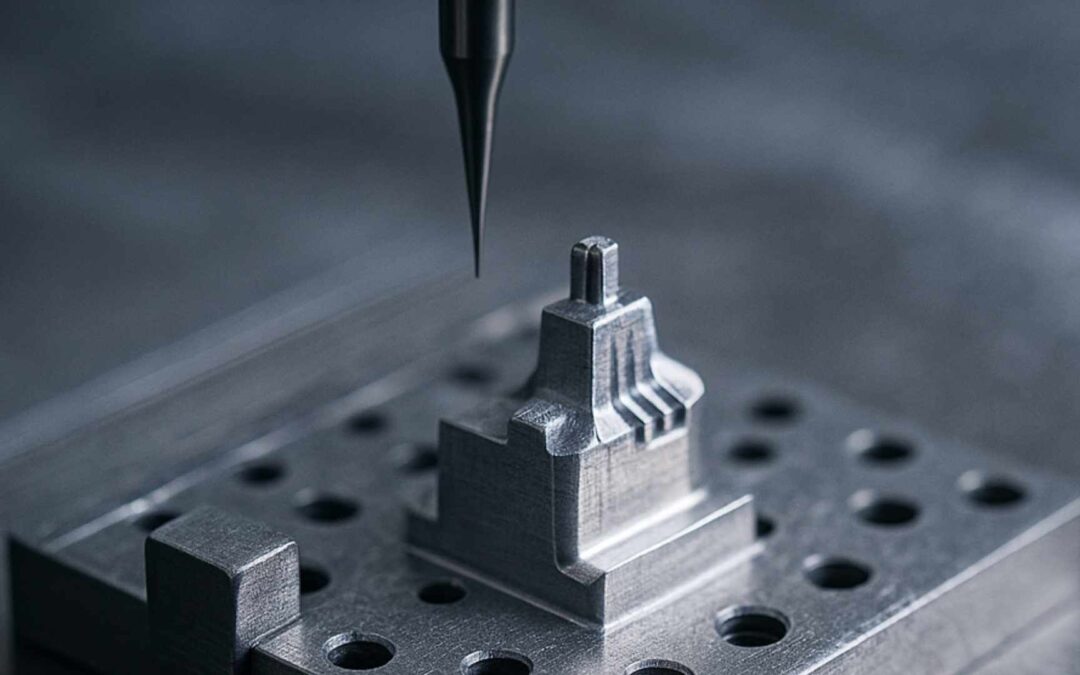
Micro-precision CNC blend milling has become a defining capability for modern aerospace manufacturers striving to achieve flawless dovetail fillet geometry across multi-stage turbine assemblies. As turbine efficiency requirements continue to rise and next-generation engines demand more intricate blade-root transitions, traditional milling strategies are no longer sufficient. Manufacturers must now rely on high-accuracy, multi-axis machining with sophisticated blend-profiling algorithms that control micro-tolerance surface transitions. This need for absolute repeatability and exceptional surface integrity has pushed CNC technology into a new domain, where thermal stability, toolpath adaptiveness, automated force prediction, and sub-micron compensation strategies operate together to achieve geometry previously considered unmachinable. In this context, micro-precision CNC blend milling is no longer merely a finishing step but a critical engineering solution that defines turbine performance, durability, and aerodynamic stability.
Unlike conventional milling methods that prioritize bulk material removal, micro-precision blend milling focuses on achieving smooth, form-true geometries along the dovetail fillet surfaces connecting turbine roots and disk seats. These transitions must follow complex curvature patterns that maintain load distribution, prevent stress concentrations, and ensure fatigue resistance throughout the turbine’s operational life. Aerospace superalloys such as Inconel, Hastelloy, and titanium alloys introduce further challenges due to their work-hardening tendencies, heat retention, and resistance to shear deformation. Blend milling strategies must therefore incorporate compensations for tool wear, heat-induced expansion, micro-deflection, and chatter susceptibility—variables that can distort the final fillet geometry if not precisely managed. Advanced toolpath algorithms now integrate curvature blending, adaptive feed optimization, jerk control, and real-time tool engagement monitoring to ensure that each radial transition remains dimensionally consistent across multi-stage assemblies. Surface accuracy is no longer measured only in microns but also in geometric continuity indices that evaluate the smoothness and predictability of the fillet’s curvature.
The complexity of multi-stage turbine dovetail designs requires hybrid CNC strategies that combine rough-profiling, semi-finish contouring, and ultra-precision blend finishing in a single unified workflow. Instead of separating these stages into disconnected operations, advanced machining centers apply high-speed data modeling to simulate the cumulative effect of each step. This prevents tolerance stacking and eliminates mismatched transitions, which historically contributed to premature cracking or blade loosening under thermal expansion. By using high-resolution spindle encoders, multi-axis synchronization algorithms, and digital-twin simulation, manufacturers now achieve consistent dovetail-fillet integration across all turbine stages. The ability to maintain ±0.002 mm fillet accuracy while also controlling the blended surface curvature places modern CNC systems in a class of their own. These machining technologies also leverage dynamic tool balancing, programmable tool-wear tracking, and real-time coolant flow mapping to maintain a stable cutting environment even in extremely tight geometries with minimal tool clearance.
One of the most important advancements in micro-precision blend milling is the implementation of automated tool deflection compensation. Traditional compensation methods relied on statistical estimates or manual offsets, but modern CNC systems incorporate predictive modeling that calculates deflection based on cutting forces, tool length, spindle load, and radial engagement at every point of the toolpath. This creates a self-correcting machining loop where micro-deviations are compensated before they accumulate. For multi-stage turbine dovetail fillet applications, where tight-radius geometries require small-diameter tools with long stick-out lengths, deflection management significantly influences final surface accuracy. Combined with high-pressure through-spindle coolant, advanced chip-evacuation logic, and temperature-stabilized machine frames, these compensation strategies allow manufacturers to maintain stable process conditions—even when machining deep, narrow sections with heavy material constraints. This integrated approach not only improves dimensional accuracy but also extends tool life and minimizes surface defects such as tearing, smearing, or micro-fracturing.
Beyond the mechanical and thermal challenges, modern CNC blend milling must also address the aerodynamic implications of turbine dovetail fillet geometry. Poorly blended fillets cause local turbulence, stress accumulation, and structural fatigue, all of which reduce overall turbine efficiency. Precision blending ensures that load paths flow naturally across blade-root surfaces, maintaining optimal stress distribution. Advanced surface-metrology systems, including laser scanners and high-resolution tactile probes, scan the finished fillet geometry to verify that it meets curvature, continuity, and smoothness requirements across the turbine stack. This data is then looped back into the CNC system through closed-feedback correction, enabling adaptive updates to future machining cycles and ensuring consistent quality across production batches. For manufacturers producing high-volume turbine blades, this feedback-enhanced workflow reinforces process reliability and creates a measurable improvement in aerodynamic performance and structural resilience.
As aerospace propulsion technology evolves, the demand for higher accuracy, cleaner transitions, and more complex fillet geometries will continue to accelerate. Micro-precision CNC blend milling provides the foundation upon which next-generation turbine performance is built. Its integration of hybrid toolpaths, adaptive process control, thermal stabilization, and intelligent compensation transforms the machining of multi-stage dovetail fillets from a high-risk operation into a predictable, repeatable, and certifiable process. Manufacturers who adopt these advanced strategies not only gain a competitive edge in production quality but also ensure long-term engine reliability for high-temperature, high-load environments. The future of turbine manufacturing will rely on even more responsive CNC systems, deeper AI-driven toolpath optimization, and enhanced material-behavior modeling—but the core principles of micro-precision blend milling will remain essential. By embracing these advanced methods, aerospace machining teams are better positioned to deliver turbine components that meet the highest standards of durability, performance, and engineering excellence.